PDF sha256 af4b16507f77d7b6efa5f9ac2dc47e590adc041d6735f05b7c255a702e0c9194. Text identical to the final draft of 2026-11-07 (source sha256
b70d5e89da9f7132…), with the byline set to this site's correspondence address.
Two-valuedness against measurement: nine spin-based theories set against published bounds
Abstract. In 1925 Pauli described the electron’s extra quantum number as “a peculiar, classically non-describable two-valuedness” [1]. Many theories since have read that two-valuedness as something more: a rotating body, a circulating charge, an axis fixed at the source, motion along a hidden direction, a source of space-time torsion, or a field of its own. This paper sets each such theory beside the published measurements that bear on it. A neutron’s wave returns after 716.8 ± 3.8° of precession, not the 360° of any rotating body, and silver atoms form two traces, not the band of a classical moment. Bell tests give S = 2.697 ± 0.015 against the preset-axis limit of 2. No Yukawa deviation from inverse-square gravity is seen above 38.6 µm, and no Kaluza–Klein graviton below 2.3–4.6 TeV in the models searched. Of nine theories, two are contradicted within their stated scope (the rotating charged electron and the preset local axis); six are not contradicted, because the measurements do not reach their predictions, the theory fixes no number that a measurement contradicts, or it is empirically equivalent to quantum mechanics; and one, the “torsion fields”, states no quantitative prediction to test. Bounds on the free parameters of these theories are listed with them. Entanglement is explained in words.
1. Introduction
Pauli introduced the electron’s fourth quantum number as a label with two values and refused to give it a mechanical picture [1]. A few months later Uhlenbeck and Goudsmit proposed that the electron rotates about its own axis [2, 3], and the word “spin” has carried that picture since. The two-valuedness itself is beyond doubt. It splits a beam of silver atoms into two [4], it sets the electron’s magnetic moment [5], and it makes a neutron’s wave return only after two full turns of precession [6].
What remains open is which pictures of it survive measurement. Section 2 collects the measurements used throughout (Table 1). Section 3 tests nine theories built on a picture of two-valuedness against them (Table 2). Section 4 gives a reading of entanglement in words. In this paper “two-valuedness” names the measured quantity; “spin” appears only inside theory names, quotations and titles.
2. Measurements
2.1 No large fourth direction
If gravity could spread into a fourth spatial direction, its force would fall faster than the inverse square wherever that direction is open. The Eöt-Wash torsion balance finds the inverse-square law holding down to 52 µm. It excludes a gravitational-strength Yukawa interaction with a range above 38.6 µm at 95 % confidence [7]. At the Moon’s distance, lunar laser ranging bounds any anomalous precession to δω/ω < 1.6 × 10⁻¹¹ [8].
2.2 No small curled direction, as far as it has been sought
A direction curled smaller than that range leaves the inverse square alone but brings a tower of heavy copies of every particle that travels in it [9]. None is seen. In high-mass diphoton events at 13 TeV, the first Kaluza–Klein excitation of the Randall–Sundrum graviton is excluded below 2.3 to 4.6 TeV, for couplings from 0.01 to 0.2 [10]. The bound holds for the named models only.
2.3 The electron: magnetic moment and size
A single electron in a Penning trap gives g/2 = 1.001 159 652 180 59 ± 0.000 000 000 000 13, a relative uncertainty of 0.13 parts per trillion [5]. Bhabha scattering at 183 and 189 GeV, combined over ALEPH, L3 and OPAL, sees no finite electron size; in a form-factor model it bounds an effective electron radius below 2.8 × 10⁻¹⁹ m at 95 % confidence [11].
2.4 Two beams and a wave that returns only after two turns
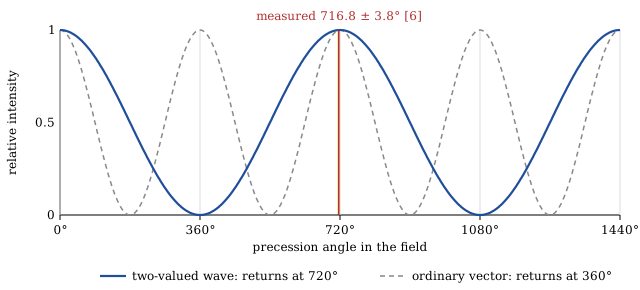
Silver atoms passing an inhomogeneous magnetic field land in two separate traces, not in one continuous band [4]. A neutron’s wave turned in a magnetic field does not return to itself after one full turn (360°). It returns after two: 716.8 ± 3.8° [6], within one standard error of 720° and 94 standard errors from 360° (Figure 1).
2.5 Bell correlations and no signalling
In the test of Clauser, Horne, Shimony and Holt [12], any pair whose two ends carry their own preset answers gives a number S of at most 2 [13]. This assumes that no influence passes between the ends and that the analyser settings are chosen independently of those answers. Quantum mechanics allows up to 2√2 ≈ 2.83 [14]. Freedman and Clauser first saw a violation, of a related inequality [15]. The measured CHSH values are:
- Aspect, Grangier, Roger: S = 2.697 ± 0.015 [16].
- Weihs et al., with the analysers switched while the photons were in flight: S = 2.73 ± 0.02 [17].
- Hensen et al., electrons in diamond 1.3 km apart, loophole-free: S = 2.42 ± 0.20 [18].
- Yin et al., from a satellite to two stations 1,203 km apart: S = 2.37 ± 0.09 [19].
All four central values lie between 2 and 2√2. They are not one number. Each apparatus has its own efficiencies, noise and state quality, so S belongs to the apparatus.
It is a theorem that what one end sees on its own cannot depend on the analyser setting chosen at the other [20, 21]. For a maximally entangled pair read with ideal analysers, each end alone reads 50/50 at every angle. Salart et al. bound any hidden influence between the ends to more than 10⁴ times the speed of light [22]. That bound rests on their stated assumption that the Earth moves slower than 10⁻³ c in any privileged frame, and the reading of their test is contested [23].
In entanglement swapping [24, 25], a joint reading of two particles, one from each of two pairs, leaves the two far particles entangled although they never met. Ma et al. made that joint reading after the far particles had already been read. It sorted the earlier outcomes into correlated groups and changed none of them.
2.6 Torsion, polarised matter, and the speed of light
A torsion pendulum carrying about 10²³ polarised electrons sees no anomalous torque from the Earth or the Sun. For ranges beyond 1 AU it bounds the dimensionless product of a monopole–dipole coupling, gPegSN in natural units, below 9.4 × 10⁻³⁷ [26]. Polarised electrons in the Earth’s mantle bound long-range dipole–dipole couplings further [27]. Read through the matching of torsion couplings to tests of Lorentz invariance, coupling-weighted combinations of 19 of the 24 independent components of a background space-time torsion are bounded, the most sensitive at the level of 10⁻³¹ GeV [28]. Photons from the burst GRB 090510, up to 31 GeV, arrived with no energy-dependent delay: |Δt/ΔE| < 30 ms GeV⁻¹ at 99 % confidence, which places the scale of any linear energy dependence of the speed of light, of either sign, above 1.2 Planck energies, under stated assumptions about the emission [29]. Equivalently, the dimensionless coefficient of such a term, in units of the inverse Planck energy, is below 0.83 in magnitude.
2.7 Supersymmetric partners at the LHC
With 139 fb⁻¹ of 13 TeV proton collisions, ATLAS finds no excess in events with jets and missing transverse momentum. In simplified models with a massless lightest neutralino it excludes gluinos below 2.30 TeV and mass-degenerate first- and second-generation squarks below 1.85 TeV, at 95 % confidence [30].
Table 1. Measurements used in this paper.
| Quantity | Measured value ± σ, or bound | Reference |
|---|---|---|
| Electron g/2 | 1.001 159 652 180 59 ± 0.000 000 000 000 13 | [5] |
| Effective electron radius (form-factor model) | < 2.8 × 10⁻¹⁹ m (95 % CL) | [11] |
| Neutron return angle | 716.8 ± 3.8° | [6] |
| Stern–Gerlach traces, silver atoms | two, separated | [4] |
| CHSH S (preset-axis limit 2) | 2.697 ± 0.015; 2.42 ± 0.20 (loophole-free) | [16]; [18] |
| Yukawa range at gravitational strength | < 38.6 µm (95 % CL) | [7] |
| First Randall–Sundrum graviton excitation | > 2.3–4.6 TeV (95 % CL, couplings 0.01–0.2) | [10] |
| Monopole–dipole coupling, gPegSN | < 9.4 × 10⁻³⁷ (range > 1 AU) | [26] |
| Background torsion (19 of 24 components, combinations) | most sensitive ≈ 10⁻³¹ GeV | [28] |
| Linear dispersion scale of light, either sign | > 1.2 Planck energies (99 % CL) | [29] |
| Gluino mass; light-squark mass | > 2.30 TeV; > 1.85 TeV (95 % CL, simplified models) | [30] |
3. Spin-based theories tested against measurement
3.1 Criterion
A theory is contradicted when a measurement in Table 1 contradicts its stated prediction beyond the quoted error or outside the quoted confidence limit. It is not contradicted when no measurement does, either because the measurements do not reach its predictions or because it predicts the same numbers as standard quantum mechanics. Where no quantitative prediction was found, this is said. Each result applies to the claim exactly as stated in its subsection, not to every theory that shares a name with it. Table 2 lists the results.
3.2 The spinning electron as a rotating charged body
Claim. The electron is a small charged body rotating about
its axis, and its two-valuedness is that rotation [2, 3].
Measurements. (i) A rotating body returns to itself after 360°;
the neutron’s wave returns after 716.8 ± 3.8° [6]. (ii) A classical
magnetic moment with random orientation spreads a beam into a band;
silver atoms form two traces [4].
Result. Contradicted as a literal rotation. Pauli’s two-valued
quantum number, which this picture was meant to explain, is
untouched.
3.3 Zitterbewegung as literal motion
Claim. The electron is a point charge circulating at the
speed of light on a circle whose radius is half the reduced Compton
wavelength, 1.93 × 10⁻¹³ m, and its two-valuedness is the angular
momentum of that orbit [31]. The oscillation itself is a term in Dirac’s
equation, found by Schrödinger [32].
Measurement. Bhabha scattering sees no electron structure down
to an effective radius of 2.8 × 10⁻¹⁹ m [11], about 7 × 10⁵ times
smaller than the orbit. Whether the orbit picture predicts a scattering
form factor of that size has not been calculated in the sources found,
so this comparison does not decide it.
Result. Not contradicted; the measurements listed here do not
decide it. The oscillating term of Dirac’s equation is an interference
between positive- and negative-energy components; it has been reproduced
in a trapped-ion simulation of the equation [33], which is a simulation,
not an observation on an electron.
3.4 A preset axis carried by each particle
Claim. Each particle of an entangled pair leaves the source
carrying its own axis, and each analyser reads that axis locally. This
is the class of local hidden-variable models of two-valuedness analysed
by Bell [13].
Measurement. Any such model gives S ≤ 2 [12]. Measured: S =
2.697 ± 0.015, 46.5 standard errors above 2 [16]; S = 2.42 ± 0.20 with
the detection and locality loopholes closed together [18].
Result. Contradicted, under the assumptions of Bell’s theorem:
independent settings and no influence between the ends.
3.5 Motion along a compact extra dimension
Claim. Internal quantities of particles are motion along a
closed extra direction of space [9]. Every particle that moves in that
direction then has a tower of heavier copies, spaced by the inverse of
its size, and gravity changes its law at distances near that size.
Measurements. No gravitational-strength Yukawa deviation above
38.6 µm [7]; no Randall–Sundrum graviton below 2.3 to 4.6 TeV
[10].
Result. Not contradicted. The theory fixes no size for the
closed direction, so no stated prediction is contradicted. The
measurements exclude a gravitational-strength Yukawa range above 38.6 µm
and, in the Randall–Sundrum models named, a first graviton excitation
below 2.3 to 4.6 TeV; a version that fixes a size or mass inside those
ranges would be contradicted.
3.6 Einstein–Cartan spin–torsion gravity
Claim. The intrinsic angular momentum of matter is a source
of space-time torsion, as mass is a source of curvature [34].
Measurements. No anomalous torque on about 10²³ polarised
electrons [26]; background torsion combinations bounded, the most
sensitive near 10⁻³¹ GeV [28].
Result. Not contradicted. In this theory torsion does not
propagate; it is confined to the inside of matter, and its effects
become large only at densities far beyond any laboratory [34]. The
measurements bound a background torsion field, which the theory does not
predict.
3.7 “Torsion fields” from rotating bodies
Claim. Rotating bodies emit long-range fields that propagate
faster than light and act with macroscopic strength on the
two-valuedness of matter. These claims were made in the 1990s outside
the peer-reviewed literature; no primary source reporting a measurement
was found.
Measurements. The polarised-electron pendulum bounds any
coupling between electron two-valuedness and the unpolarised matter of
the Earth and Sun below 9.4 × 10⁻³⁷ for ranges beyond 1 AU [26], and the
mantle electrons bound long-range dipole–dipole couplings [27].
Result. No number stated. No quantitative prediction was found
to set against these bounds. Any long-range coupling of electron
two-valuedness to unpolarised matter beyond 1 AU must lie below the
bound above.
3.8 Spin networks and a discrete space that slows light
Claim. Space is a network of discrete quanta whose edges
carry SU(2) representation labels, the spins of the theory’s name, of
which one half is the smallest nonzero value [35]. In some versions the
speed of light then depends on its energy at first order in its ratio to
the Planck energy; in the version of Gambini and Pullin the sign depends
on the photon’s helicity [36].
Measurement. GRB 090510: no delay up to 31 GeV; a linear
dispersion scale of either sign above 1.2 Planck energies, a coefficient
below 0.83 in magnitude [29].
Result. Not contradicted. Neither the network theory [35] nor
the Gambini–Pullin version [36] fixes the value of the coefficient, so
no stated prediction is contradicted. The measurement bounds any linear
dispersion coefficient below 0.83 in magnitude, for either sign, under
the stated emission assumptions; a version that fixes a larger
coefficient would be contradicted.
3.9 Supersymmetric partners
Claim. Each particle has a partner whose spin quantum
number, in the theory’s terms, differs by one half [37], and in the
versions built to stabilise the weak scale these partners lie near 1
TeV.
Measurement. No gluino below 2.30 TeV and no light squark below
1.85 TeV in simplified models with a massless lightest neutralino
[30].
Result. Not contradicted. The theory fixes no partner mass; a
scale near 1 TeV is an expectation of naturalness, not a prediction of
the theory. The search bounds gluinos and light squarks in the
simplified models named; heavier partners, compressed spectra, other
decay chains and a massive lightest neutralino are not excluded.
3.10 The Bohm–Schiller–Tiomno rotating fluid
Claim. The two-valued wave is a fluid whose internal
rotation carries the two-valuedness, and particles follow its flow
[38].
Measurement. None separates it from quantum mechanics. By
construction it reproduces the statistics of the Pauli equation,
including the 720° return [6] and the two Stern–Gerlach traces
[4].
Result. Not contradicted. It is empirically equivalent to
quantum mechanics for these measurements; the rotation it posits is not
itself observed.
Table 2. Spin-based theories and the measurements that bear on them.
| Theory (section) | Measurement | Result |
|---|---|---|
| Rotating charged electron (3.2) | 716.8 ± 3.8°; two Stern–Gerlach traces | Contradicted |
| Zitterbewegung as a literal orbit (3.3) | effective radius < 2.8 × 10⁻¹⁹ m against 1.93 × 10⁻¹³ m; no form-factor prediction found | Not contradicted (not decided) |
| Preset local axis (3.4) | S = 2.697 ± 0.015; 2.42 ± 0.20 loophole-free | Contradicted |
| Compact extra dimension (3.5) | Yukawa < 38.6 µm; RS graviton > 2.3–4.6 TeV | Not contradicted (no size fixed by the theory; bounds in named models) |
| Einstein–Cartan torsion (3.6) | torsion combinations ≈ 10⁻³¹ GeV; pendulum null | Not contradicted (beyond reach) |
| “Torsion fields” (3.7) | coupling < 9.4 × 10⁻³⁷; no quantitative claim found | No number stated |
| Spin network with linear dispersion (3.8) | scale > 1.2 Planck energies; coefficient < 0.83 | Not contradicted (coefficient not fixed by the theory; bound < 0.83) |
| Supersymmetric partners (3.9) | gluino > 2.30 TeV; squark > 1.85 TeV | Not contradicted (no mass fixed by the theory; bounds in simplified models) |
| Bohm–Schiller–Tiomno fluid (3.10) | none decides | Not contradicted (equivalent) |
3.11 What the measurements leave
Each contradicted picture gives two-valuedness a mechanism made of something else, a body that turns or an axis that travels with the particle, and each predicts a number that a listed measurement contradicts. What survives every listed measurement is the property as Pauli stated it: two-valued, measured to 0.13 parts per trillion in the electron’s moment, and returning after 720° rather than 360°. The not contradicted theories are not contradicted because the measurements do not reach them, because they fix no number that the measurements contradict, or because the measurements cannot separate them from quantum mechanics, not because a measurement supports them.
4. Entanglement in words
Two experimental facts set the picture. The ends agree more than any pair of preset answers could. Neither end can be used to signal the other [20, 21].
4.1 The picture
Take a single wave, one object, tied at two ends. Each particle is one end. The pair is not two things that carry copies of an answer. It is one thing with two places where it can be read. The two outcomes are two faces of one reading.
4.2 Why this matches the numbers
If each end kept its own copy of a shared value and read it separately, the result could not exceed S = 2. Each CHSH value in Section 2.5 refutes that, the first [16] by 46.5 standard errors. If the wave is read once for both ends, the correlation is the standard quantum one for the two analyser angles. The picture takes that rule from quantum mechanics as given and does not derive it. With ideal analysers, S then reaches the ceiling 2√2. Noise, imperfect state preparation and, in tests that count every trial, detector loss bring S down to the measured 2.37 to 2.73.
4.3 Why no usable signal passes
A single reading of the whole wave fixes how the two outcomes relate. It does not fix either outcome on its own, so each end on its own sees a fair coin (for a maximally entangled pair). The correlation shows only when the two records are brought together and compared. The joint reading describes the correlation; it carries nothing from one end to the other that either end could control or detect on its own.
4.4 Where the wave is tied
It is not tied to places. Yin et al. kept the correlation with the two ends 1,203 km apart, carried from a satellite [19]. The wave goes with the particles. The picture needs no extra direction of space and no hidden axis along which the pair is “connected”. The measurements of Sections 2 and 3 find no such direction in the ranges probed and exclude a preset local axis, and the picture works without either.
5. Conclusions
Nine theories that give two-valuedness a picture beyond Pauli’s were set against published measurements. Two are contradicted in their stated form and scope: the rotating charged electron and the preset local axis. Six are not contradicted: zitterbewegung as an orbit, which these measurements do not decide; Einstein–Cartan torsion, whose predictions lie beyond present reach; the compact extra dimension, the spin network and supersymmetry, which fix no number the measurements contradict, though the measurements bound their free parameters; and the Bohm–Schiller–Tiomno fluid, which is empirically equivalent to quantum mechanics. The “torsion fields” state no quantitative prediction to set against a measurement. In every contradicted case the decisive number is a published measurement with its error and confidence level.
Data availability
No new data were generated. All values are taken from the cited publications; the arithmetic in Sections 2 and 3 (ratios and standard-error distances) is reproducible from Table 1 with the CODATA 2018 constants.
Competing interests
The author declares no competing interests.
Funding and tools
Funding: none. Tools: [statement on computational assistance to be set on legal advice].
References
[1] W. Pauli, Über den Zusammenhang des Abschlusses der Elektronengruppen im Atom mit der Komplexstruktur der Spektren, Z. Phys. 31, 765 (1925). doi:10.1007/BF02980631
[2] G. E. Uhlenbeck and S. Goudsmit, Ersetzung der Hypothese vom unmechanischen Zwang durch eine Forderung bezüglich des inneren Verhaltens jedes einzelnen Elektrons, Naturwissenschaften 13, 953 (1925). doi:10.1007/BF01558878
[3] G. E. Uhlenbeck and S. Goudsmit, Spinning electrons and the structure of spectra, Nature 117, 264 (1926). doi:10.1038/117264a0
[4] W. Gerlach and O. Stern, Der experimentelle Nachweis der Richtungsquantelung im Magnetfeld, Z. Phys. 9, 349 (1922). doi:10.1007/BF01326983
[5] X. Fan, T. G. Myers, B. A. D. Sukra, and G. Gabrielse, Measurement of the electron magnetic moment, Phys. Rev. Lett. 130, 071801 (2023). doi:10.1103/PhysRevLett.130.071801
[6] H. Rauch, A. Wilfing, W. Bauspiess, and U. Bonse, Precise determination of the 4π-periodicity factor of a spinor wave function, Z. Phys. B 29, 281 (1978). doi:10.1007/BF01321193
[7] J. G. Lee, E. G. Adelberger, T. S. Cook, S. M. Fleischer, and B. R. Heckel, New test of the gravitational 1/r² law at separations down to 52 µm, Phys. Rev. Lett. 124, 101101 (2020). doi:10.1103/PhysRevLett.124.101101
[8] E. G. Adelberger, B. R. Heckel, and A. E. Nelson, Tests of the gravitational inverse-square law, Annu. Rev. Nucl. Part. Sci. 53, 77 (2003). doi:10.1146/annurev.nucl.53.041002.110503
[9] T. Kaluza, Zum Unitätsproblem der Physik, Sitzungsber. Preuss. Akad. Wiss. Berlin (Math. Phys.), 966 (1921); O. Klein, Quantentheorie und fünfdimensionale Relativitätstheorie, Z. Phys. 37, 895 (1926). doi:10.1007/BF01397481
[10] CMS Collaboration (A. M. Sirunyan et al.), Search for physics beyond the standard model in high-mass diphoton events from proton-proton collisions at √s = 13 TeV, Phys. Rev. D 98, 092001 (2018). doi:10.1103/PhysRevD.98.092001
[11] D. Bourilkov, Search for TeV strings and new phenomena in Bhabha scattering at CERN LEP2, Phys. Rev. D 62, 076005 (2000). doi:10.1103/PhysRevD.62.076005
[12] J. F. Clauser, M. A. Horne, A. Shimony, and R. A. Holt, Proposed experiment to test local hidden-variable theories, Phys. Rev. Lett. 23, 880 (1969). doi:10.1103/PhysRevLett.23.880
[13] J. S. Bell, On the Einstein Podolsky Rosen paradox, Physics 1, 195 (1964). doi:10.1103/PhysicsPhysiqueFizika.1.195
[14] B. S. Cirel’son (Tsirelson), Quantum generalizations of Bell’s inequality, Lett. Math. Phys. 4, 93 (1980). doi:10.1007/BF00417500
[15] S. J. Freedman and J. F. Clauser, Experimental test of local hidden-variable theories, Phys. Rev. Lett. 28, 938 (1972). doi:10.1103/PhysRevLett.28.938
[16] A. Aspect, P. Grangier, and G. Roger, Experimental realization of Einstein-Podolsky-Rosen-Bohm Gedankenexperiment: a new violation of Bell’s inequalities, Phys. Rev. Lett. 49, 91 (1982). doi:10.1103/PhysRevLett.49.91
[17] G. Weihs, T. Jennewein, C. Simon, H. Weinfurter, and A. Zeilinger, Violation of Bell’s inequality under strict Einstein locality conditions, Phys. Rev. Lett. 81, 5039 (1998). doi:10.1103/PhysRevLett.81.5039
[18] B. Hensen et al., Loophole-free Bell inequality violation using electron spins separated by 1.3 kilometres, Nature 526, 682 (2015). doi:10.1038/nature15759
[19] J. Yin et al., Satellite-based entanglement distribution over 1200 kilometers, Science 356, 1140 (2017). doi:10.1126/science.aan3211
[20] P. H. Eberhard, Bell’s theorem and the different concepts of locality, Nuovo Cimento B 46, 392 (1978). doi:10.1007/BF02728628
[21] G. C. Ghirardi, A. Rimini, and T. Weber, A general argument against superluminal transmission through the quantum mechanical measurement process, Lett. Nuovo Cimento 27, 293 (1980). doi:10.1007/BF02817189
[22] D. Salart, A. Baas, C. Branciard, N. Gisin, and H. Zbinden, Testing the speed of ‘spooky action at a distance’, Nature 454, 861 (2008). doi:10.1038/nature07121
[23] J. Kofler, R. Ursin, Č. Brukner, and A. Zeilinger, Comment on: Testing the speed of ‘spooky action at a distance’, arXiv:0810.4452 (2008).
[24] J.-W. Pan, D. Bouwmeester, H. Weinfurter, and A. Zeilinger, Experimental entanglement swapping: entangling photons that never interacted, Phys. Rev. Lett. 80, 3891 (1998). doi:10.1103/PhysRevLett.80.3891
[25] X.-S. Ma et al., Experimental delayed-choice entanglement swapping, Nat. Phys. 8, 479 (2012). doi:10.1038/nphys2294
[26] B. R. Heckel, E. G. Adelberger, C. E. Cramer, T. S. Cook, S. Schlamminger, and U. Schmidt, Preferred-frame and CP-violation tests with polarized electrons, Phys. Rev. D 78, 092006 (2008). doi:10.1103/PhysRevD.78.092006
[27] L. Hunter, J. Gordon, S. Peck, D. Ang, and J.-F. Lin, Using the Earth as a polarized electron source to search for long-range spin-spin interactions, Science 339, 928 (2013). doi:10.1126/science.1227460
[28] V. A. Kostelecký, N. Russell, and J. D. Tasson, Constraints on torsion from bounds on Lorentz violation, Phys. Rev. Lett. 100, 111102 (2008). doi:10.1103/PhysRevLett.100.111102
[29] A. A. Abdo et al. (Fermi LAT and GBM Collaborations), A limit on the variation of the speed of light arising from quantum gravity effects, Nature 462, 331 (2009). doi:10.1038/nature08574
[30] ATLAS Collaboration, Search for squarks and gluinos in final states with jets and missing transverse momentum using 139 fb⁻¹ of √s = 13 TeV pp collision data with the ATLAS detector, J. High Energy Phys. 02, 143 (2021). doi:10.1007/JHEP02(2021)143
[31] D. Hestenes, The zitterbewegung interpretation of quantum mechanics, Found. Phys. 20, 1213 (1990). doi:10.1007/BF01889466
[32] E. Schrödinger, Über die kräftefreie Bewegung in der relativistischen Quantenmechanik, Sitzungsber. Preuss. Akad. Wiss. Berlin (Phys.-Math. Kl.) 24, 418 (1930).
[33] R. Gerritsma, G. Kirchmair, F. Zähringer, E. Solano, R. Blatt, and C. F. Roos, Quantum simulation of the Dirac equation, Nature 463, 68 (2010). doi:10.1038/nature08688
[34] F. W. Hehl, P. von der Heyde, G. D. Kerlick, and J. M. Nester, General relativity with spin and torsion: foundations and prospects, Rev. Mod. Phys. 48, 393 (1976). doi:10.1103/RevModPhys.48.393
[35] C. Rovelli and L. Smolin, Spin networks and quantum gravity, Phys. Rev. D 52, 5743 (1995). doi:10.1103/PhysRevD.52.5743
[36] R. Gambini and J. Pullin, Nonstandard optics from quantum space-time, Phys. Rev. D 59, 124021 (1999). doi:10.1103/PhysRevD.59.124021
[37] J. Wess and B. Zumino, Supergauge transformations in four dimensions, Nucl. Phys. B 70, 39 (1974). doi:10.1016/0550-3213(74)90355-1
[38] D. Bohm, R. Schiller, and J. Tiomno, A causal interpretation of the Pauli equation (A), Nuovo Cimento Suppl. 1, 48 (1955). doi:10.1007/BF02743528