Intuition
Two pictures carry the whole result. I draw them here; the numbers that hold them up are on the Proof page.
1. One wave, tied at two ends
I picture an entangled pair as one wave tied at two points. Each particle is one end. The pair is not two things that each carry a copy of an answer; it is one thing with two places where it can be read. When it is read, it is read once, for both ends, and the two outcomes are two faces of that one reading.
Why this beats preset answers. If each end carried its own copy of a shared value and read it separately, the Bell number S could never exceed 2. Every Bell test since 1972 is above 2: 2.697 ± 0.015 in 1982, 2.42 ± 0.20 with every loophole closed in 2015. Read once for both ends, the correlation is the standard quantum one, and S reaches 2√2 ≈ 2.83 for ideal analysers. I take that correlation from quantum mechanics as given; the picture explains why one reading gives more than two separate readings, it does not derive the formula.
Why no signal passes. A real rope, pulled at one end, moves the other. This one does not: the single reading fixes how the two outcomes relate, not either outcome alone, so each end on its own sees a fair coin, whatever the far end does. The relation shows only when the two records are brought together.
Where the wave is tied. Not to places. The correlation stayed with the ends 1,203 km apart, carried from a satellite. The wave goes with the particles.
2. No fourth direction
A force spreading from a mass thins out over the surface around it. In three directions that surface grows as the distance squared, so the pull falls as one over the distance squared. If gravity could also spread into a fourth direction, the surface would grow one power faster wherever that direction is open, and the pull would fall faster there. Multiply the pull by the distance squared and the ordinary law is a flat line; an open fourth direction bends it up at distances below its size.
A direction curled up smaller than that leaves the inverse square alone, but every particle that moves in it would come with a ladder of heavier copies. None is seen: in the Randall–Sundrum models searched, no first copy of the graviton below 2.3–4.6 TeV. So the wave tied at two ends does not run through a hidden direction. It needs none, and the measurements find none in the ranges probed.
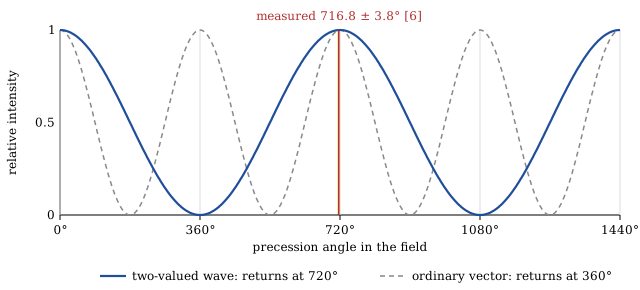
3. Two turns, not one