Examples
1. The rope simulation
An entangled pair drawn as one wave tied at two ends. Turn the two analysers, watch the correlation, and run the CHSH test with 10,000 pairs from a fixed sequence (no random numbers, the same counts every time). Open the simulation.
2. The CHSH run
Settings a = 0, a′ = 90°, b = 45°, b′ = 135° in the two-valued angle (the photon tests use half these polariser angles). The reproduction script computes S three ways over 36,000 fixed phases:
each end reads a shared preset value, probabilistically   S = 1.4142
each end reads the sign of a shared preset value          S = 2.0000   (Bell's bound)
the wave read once for both ends                          S = 2.8284   (Tsirelson's ceiling 2√2)
Measured: 2.697 ± 0.015 (Aspect 1982). Distance from the preset-answer bound: (2.697 − 2) / 0.015 = 46.5 standard errors.
3. The 720° return of the neutron
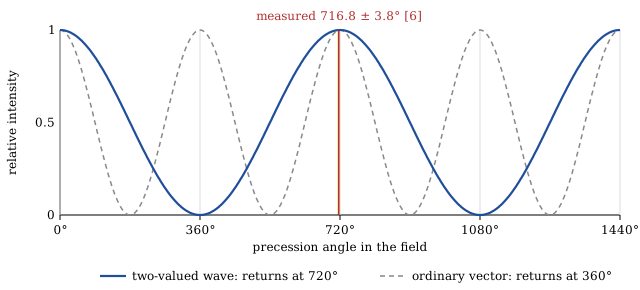
Worked: (716.8 − 720) / 3.8 = −0.84 standard errors from 720°; (716.8 − 360) / 3.8 = +93.9 from 360°. A rotating body is contradicted by 94 standard errors.
4. A worked number: one metre of height
A clock raised by h runs fast by g h / c². For h = 1 m: 9.80665 / (2.99792458 × 10⁸)² = 1.091e-16 per metre, or 9.43 picoseconds per day. Strontium clocks resolve the gradient across a single millimetre: measured 9.8 ± 2.3 × 10⁻²⁰ per mm against 1.09e-19 predicted (Bothwell et al. 2022), z = -0.48.
5. A worked number: antimatter falls
ALPHA-g measured 0.75 ± 0.21 g for antihydrogen. Against 1 g: (0.75 − 1) / 0.206 = −1.21 standard errors: agrees. Against −1 g (antimatter rising): (0.75 + 1) / 0.206 = +8.5: contradicted.